
STATEMENT OF THE NATIONAL DEMOCRATIC ALLIANCE On Armenia’s Sovereignty over Tigranashen and the So-Called Tavush Enclaves • August 22 at 1:37 PM
On the Inalienability of the Sovereignty of the Republic of Armenia over Tigranashen and the Two So-Called Enclaves in Tavush
The Council of the National Democratic Alliance strongly condemns the statement by Nikol Pashinyan—who proclaimed himself the winner and usurped power on June 7—whereby the village of Tigranashen, covering approximately 8.4 square kilometres, is presented as lying outside the territory of the Republic of Armenia. The Council equally firmly rejects any possibility of surrendering the two so-called enclaves in Tavush Province, with a combined area of approximately 35 square kilometres, in the absence of publicly demonstrated, indisputable legal title held by Azerbaijan and without the will of the Armenian people expressed in accordance with the Constitution.
This statement is unprecedented, legally unfounded, unconstitutional, and extremely dangerous from the standpoint of national security. No valid legal, historical, or documentary basis for it has been presented to the public, and it creates a dangerous precedent for the unilateral alienation of territory of the Republic of Armenia.
Article 205 of the Constitution of the Republic of Armenia unequivocally provides that matters concerning changes to the territory of Armenia shall be decided exclusively by referendum. Consequently, no public official, including the prime minister, has the authority—through a personal statement, political arrangement, or reliance on a map lacking legal force—to declare any Armenian settlement or territory to be outside the Republic of Armenia. The territory of the Republic of Armenia is not an object at the disposal of the executive branch. It belongs to the Armenian people and may be altered only through the will of the people expressed in the manner prescribed by the Constitution.
Should statements presenting Tigranashen or the two alleged enclaves in Tavush as lying outside the Republic of Armenia be translated into decisions or actions aimed at their actual alienation, those decisions and actions must receive constitutional and criminal-law assessment under the legislation of the Republic of Armenia concerning the protection of state sovereignty, territorial integrity, and national security.
The Strategic Importance of Tigranashen
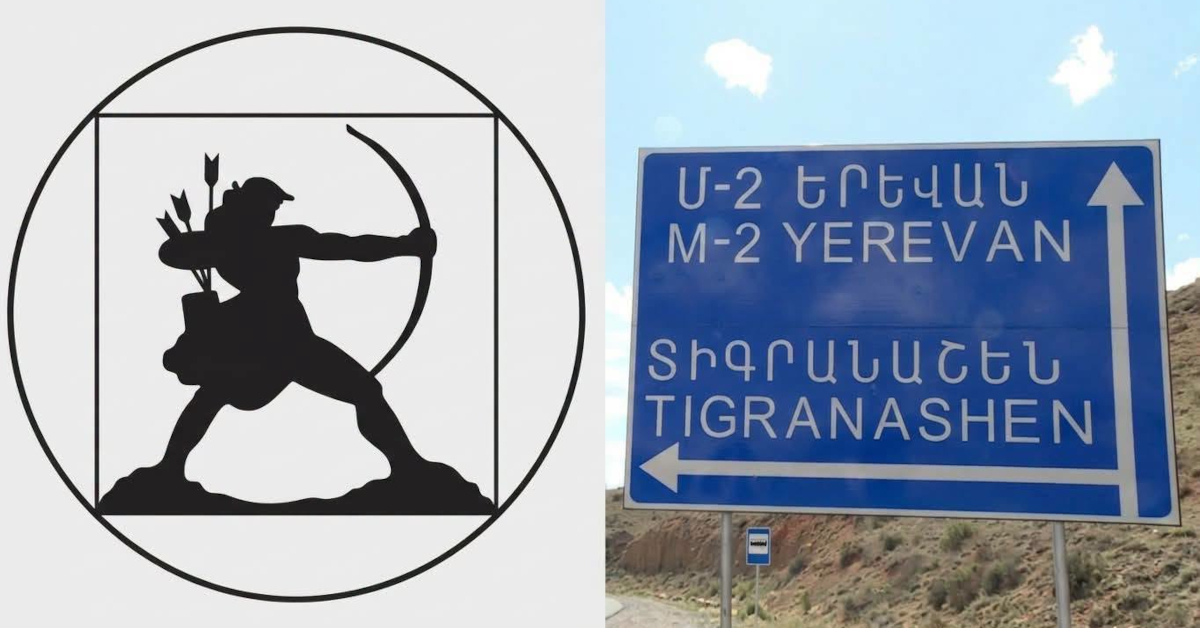
Tigranashen is not an ordinary border settlement. It lies on the M-2 interstate highway, which is of vital importance to the Republic of Armenia. This road connects Armenia’s main territory with the provinces of Vayots Dzor and Syunik, as well as with the Islamic Republic of Iran. The establishment of Azerbaijani control over Tigranashen and the adjacent section of the road would profoundly and irreversibly endanger:
● safe and uninterrupted links between Armenia’s main territory and the provinces of Vayots Dzor and Syunik;
● Armenia’s communications with the Islamic Republic of Iran;
● Armenia’s foreign-trade and transit opportunities;
● the country’s military, economic, and energy security;
● Armenia’s future as a sovereign transit state.
It is unacceptable to place any section of Armenia’s strategic highway under the control of a state that has pursued a hostile policy toward Armenia for decades, or to make Armenia’s domestic communications dependent on that state’s arbitrary decisions. Tigranashen’s importance will increase further once the India–Iran–Armenia–Georgia–Black Sea–Europe international transport route becomes fully operational. That project could turn Armenia into an important transit hub linking the Indian Ocean and the Persian Gulf with the Black Sea and Europe. The loss of Armenian sovereignty over Tigranashen would endanger not only Armenia’s internal communications, but also the security, continuity, and reliability of this strategically important international route.
Consequences of Surrendering the So-Called Enclaves in Tavush
The surrender of the so-called enclaves in Tavush would likewise be no ordinary border adjustment. Establishing Azerbaijani control over these territories would create pockets controlled by a foreign state deep inside Armenia’s northeastern province. It would sever, or place under permanent threat, the Armenia–Georgia interstate road and intercommunity roads, access to agricultural land and pastures, and the normal life of border communities.
Such a decision could:
● endanger the security of Voskepar, Kirants, Baghanis, and neighbouring communities, as well as residents’ freedom of movement and use of their property;
● provide Azerbaijan with new military and observation positions inside Armenian territory or in its immediate vicinity;
● render Armenia’s northeastern communications and its vital road link with Georgia vulnerable;
● increase the risks of blockade, road closures, forced displacement of the population, and new territorial claims;
● undermine the defensive integrity of Tavush and the governability of the sovereign territory of the Republic of Armenia.
The surrender of the so-called enclaves in Tavush would therefore represent not merely a territorial loss, but also a long-term military-political, communications, economic, and demographic threat. No government has the authority to adopt a decision with such consequences through closed negotiations or on the basis of maps lacking legal force.
The Existence of Any Legally Established Azerbaijani Enclave Has Not Been Proven
To date, the public has not been shown any act adopted by a competent Soviet authority and approved through the proper legal procedure that terminated Armenian jurisdiction over Tigranashen and the two alleged enclaves in Tavush and lawfully transferred those territories to Soviet Azerbaijan.
The mere depiction of a territory in a particular colour on a Soviet administrative map does not in itself create territorial title or prove the legal attribution of sovereignty.
A map may have auxiliary technical or evidentiary significance only if it:
1. is annexed to a legally authoritative interstate instrument determining the boundary;
2. has been identified and authenticated by the competent parties;
3. contains an appropriate scale, a description of the boundary line, and the necessary coordinates;
4. was adopted in accordance with the constitutional and legal procedures applicable at the time.
A map that does not meet these conditions is not legal title. Without a corresponding legal act, it is merely a cartographic image—a coloured picture—that cannot serve as a basis for alienating territory of the Republic of Armenia. Moreover, Soviet maps from different periods frequently contradict one another. Many were prepared for administrative-economic, land-use, military, or technical purposes and were not legal instruments determining an interstate boundary. The lawful existence of any “Azerbaijani enclave” therefore cannot be regarded as established until a valid legal act of a duly competent authority concerning its creation or transfer is published, together with the relevant record and attached map.
The Alma-Ata Declaration Is Not a Delimitation Instrument
The reliance by Nikol Pashinyan—who proclaimed himself the winner and usurped power on June 7—on the Alma-Ata Declaration of 21 December 1991 is legally incomplete, selective, and unfounded. The Alma-Ata Declaration is not a boundary-delimitation treaty. It contains no description of the Armenian-Azerbaijani border, no coordinates of the boundary line, no list of legally authoritative maps, and no authentication of such maps. No map determining the border between Armenia and Azerbaijan and approved by both states is attached to the Declaration.
The Alma-Ata Declaration therefore cannot, by itself, determine which state a particular village, road, or parcel of land belongs to. Furthermore, its provisions concerning territorial integrity and respect for existing borders are neither isolated nor absolute. They form part of an interconnected body of principles.
The participating states undertook to build their relations on the following foundations:
● mutual recognition of and respect for state sovereignty;
● sovereign equality;
● the inalienable right of peoples to self-determination;
● equality of rights;
● non-interference in one another’s internal affairs;
● renunciation of the use or threat of force;
● renunciation of economic and other forms of coercion;
● peaceful settlement of disputes;
● respect for human rights and fundamental freedoms;
● protection of the rights of national minorities;
● good-faith performance of international obligations;
● maintenance of international peace and security.
An international instrument must be interpreted and applied in good faith, as a whole, and in the context of its object and purpose. One provision cannot be selectively extracted while the other principles and obligations embodied in the same instrument are ignored.
For decades, Azerbaijan has systematically violated almost all the fundamental principles of the Alma-Ata Declaration. It has used force and the threat of force against Armenia and Artsakh, carried out military aggression, invaded the sovereign territory of the Republic of Armenia, employed blockade and economic coercion, refused a genuinely peaceful settlement of disputes, and violated the rights of the Armenian population of Artsakh to self-determination, security, property, and return to their homeland. Azerbaijan cannot selectively invoke the Alma-Ata Declaration to demand territorial concessions from Armenia while continuing to violate the principles underlying that same Declaration.
Azerbaijan’s Legal Contradiction
Under the Constitutional Act on the State Independence of the Republic of Azerbaijan of 18 October 1991, present-day Azerbaijan declared itself the legal successor of the Azerbaijan Democratic Republic of 1918–1920. The same Act portrayed the establishment of Soviet rule in Azerbaijan in April 1920 as the result of foreign military intervention and occupation carried out in violation of international law.
Thus, in its founding document of state independence, Azerbaijan linked its state and legal continuity not to the Azerbaijan SSR but to the Azerbaijan Democratic Republic of 1918–1920, characterising the establishment of Soviet rule as unlawful occupation. Azerbaijan consequently cannot, without clear legal justification, reject the Soviet state legacy on the one hand while advancing territorial claims against Armenia on the other by selectively relying on Soviet administrative maps or alleged Soviet boundaries.
If Azerbaijan claims that any territory was lawfully transferred to it during the Soviet period, it must produce the complete legal basis for that transfer, including:
● the decision of the competent authority;
● proof of that authority’s competence;
● the constitutional procedure by which the decision was adopted;
● Armenia’s consent;
● the legal description of the boundary line;
● the duly authenticated map attached to the legal act.
In the absence of such documents, Azerbaijan’s territorial claims cannot be regarded as legally substantiated.
The Report and Proposals of 24 February 1920
Among the historical and legal foundations for determining the boundary between Armenia and Azerbaijan, particular importance attaches to the League of Nations document of 24 February 1920, Report and Proposals of the Commission for the Delimitation of the Boundaries of Armenia. The document was prepared by a special commission mandated to determine Armenia’s boundaries, operating within the framework of the Paris Peace Conference and authorised by the League of Nations. It was signed by the plenipotentiary representatives of the British Empire, France, Italy, and Japan, members of the Council—the League’s highest body.
It remains the only known comprehensive legal report and proposal adopted by a competent international body concerning the determination of the boundaries between Armenia and Azerbaijan. Its principles were subsequently reflected in Article 92 of the Treaty of Sèvres of 10 August 1920. As an official document, the Report and Proposals of 24 February was also included as Annex I to the complete report accompanying U.S. President Woodrow Wilson’s Arbitral Award of 22 November 1920.
Accordingly, the boundary between Armenia and Azerbaijan cannot lawfully be determined on the basis of an isolated Soviet-era map of unknown origin and lacking any legal status or value, while disregarding this report and proposal adopted by a competent international body and the procedure it established.Obligations of the Self-Proclaimed Authorities
Nikol Pashinyan—who proclaimed himself the winner and usurped power on June 7—and his government are obliged to:
1. immediately renounce all statements, negotiating positions, and arrangements presenting Tigranashen and the two alleged enclaves in Tavush as lying outside the Republic of Armenia, as well as any plan to surrender those territories to Azerbaijan;
2. publish the entire negotiating dossier concerning Tigranashen and the two so-called enclaves in Tavush, including all maps, records, legal opinions, alleged decisions of Soviet bodies, and all other underlying documents;
3. officially include among the legal and historical foundations for delimiting the boundary between Armenia and Azerbaijan, and place on the international agenda, the principles contained in the Report and Proposals of the Commission for the Delimitation of the Boundaries of Armenia of 24 February 1920;
4. conduct the delimitation process exclusively on the basis of international law, instruments embodying legal title, the Constitution of the Republic of Armenia, and acts adopted by competent international bodies;
5. reject as a basis for delimitation any map that is not annexed to a legally authoritative boundary instrument, has not been identified and authenticated by the relevant parties, or lacks a legally valid description of the boundary line;
6. rule out any change to the territory of the Republic of Armenia without the nationwide referendum required by Article 205 of the Constitution; no public official, government, or parliamentary majority has the authority to alienate any part of the territory of the Republic of Armenia by its own decision;
7. ensure the security, freedom of movement, property rights, and uninterrupted ability to live in their native communities of the residents of Tigranashen and the threatened settlements of Tavush;
8. preserve the full, indivisible, and exclusive sovereignty of the Republic of Armenia over Tigranashen and the M-2 interstate highway, as well as over the so-called enclaves in Tavush and their adjoining roads and territories;
9. rule out any border or road regime that would make the connection between Armenia’s main territory and Vayots Dzor, Syunik, and Iran, as well as communications between Tavush communities and in the direction of Georgia, dependent on Azerbaijan’s control or consent;
10. establish an independent professional commission to examine the legal status of Tigranashen and the so-called enclaves in Tavush, with the participation of specialists in international law, diplomatic historians, cartographers, archivists, demographers, and security experts;
11. officially present the Report and Proposals of 24 February 1920 to the relevant international organisations and Armenia’s partner states as an overlooked yet fundamentally important document in the legal history of the Armenian-Azerbaijani boundary;
12. ensure that all state bodies adopt a public, clear, and unequivocal position regarding Tigranashen, the so-called enclaves in Tavush, and Armenia’s territorial integrity.
All Armenian political forces, civil-society organisations, academic institutions, and professional circles are obliged to express a clear, public, and unequivocal position regarding Tigranashen, the so-called enclaves in Tavush, and Armenia’s territorial integrity. Silence or ambiguous wording on this matter may be perceived as tacit consent to a policy of unilateral alienation of Armenian territory.
Tigranashen is sovereign territory of the Republic of Armenia unless and until the contrary is established by indisputable legal title and by the will of the Armenian people expressed in the manner prescribed by the Constitution. The same principle applies to the so-called enclaves in Tavush: their surrender cannot be deemed lawful without Azerbaijan’s indisputable legal title and the will of the Armenian people expressed in accordance with the Constitution.
The territory of the Republic of Armenia is not a subject of bargaining.
The territory of the Republic of Armenia cannot be alienated by the statement of any public official, through secret negotiations, or on the basis of a map lacking legal force. Preserving the full sovereignty of the Republic of Armenia over Tigranashen and the so-called enclaves in Tavush is a matter of defending Armenia’s independence, territorial integrity, communications security, and future as a state.
COUNCIL OF THE NATIONAL DEMOCRATIC ALLIANCE
22 August 2026, Yerevan